You can learn a surprising amount about someone before they ever tell you who they are.
Listen to them speak for a few minutes. Their dialect might hint at where they grew up. Certain words might reveal their generation. The way they pronounce a single word can sometimes tell another speaker exactly where they’re from.
Language doesn’t just tell people what we mean. It tells them something about who we are.
This is especially visible in Arabic, because Arabic rarely comes in just one form. There’s Fusha, the Arabic of books, news, education, and formal writing, and there are the dialects, the Arabic of home, friendship, family, and everyday life.
Arabic speakers move between these forms constantly, often without even thinking about it.
The Same Idea, Said Two Ways
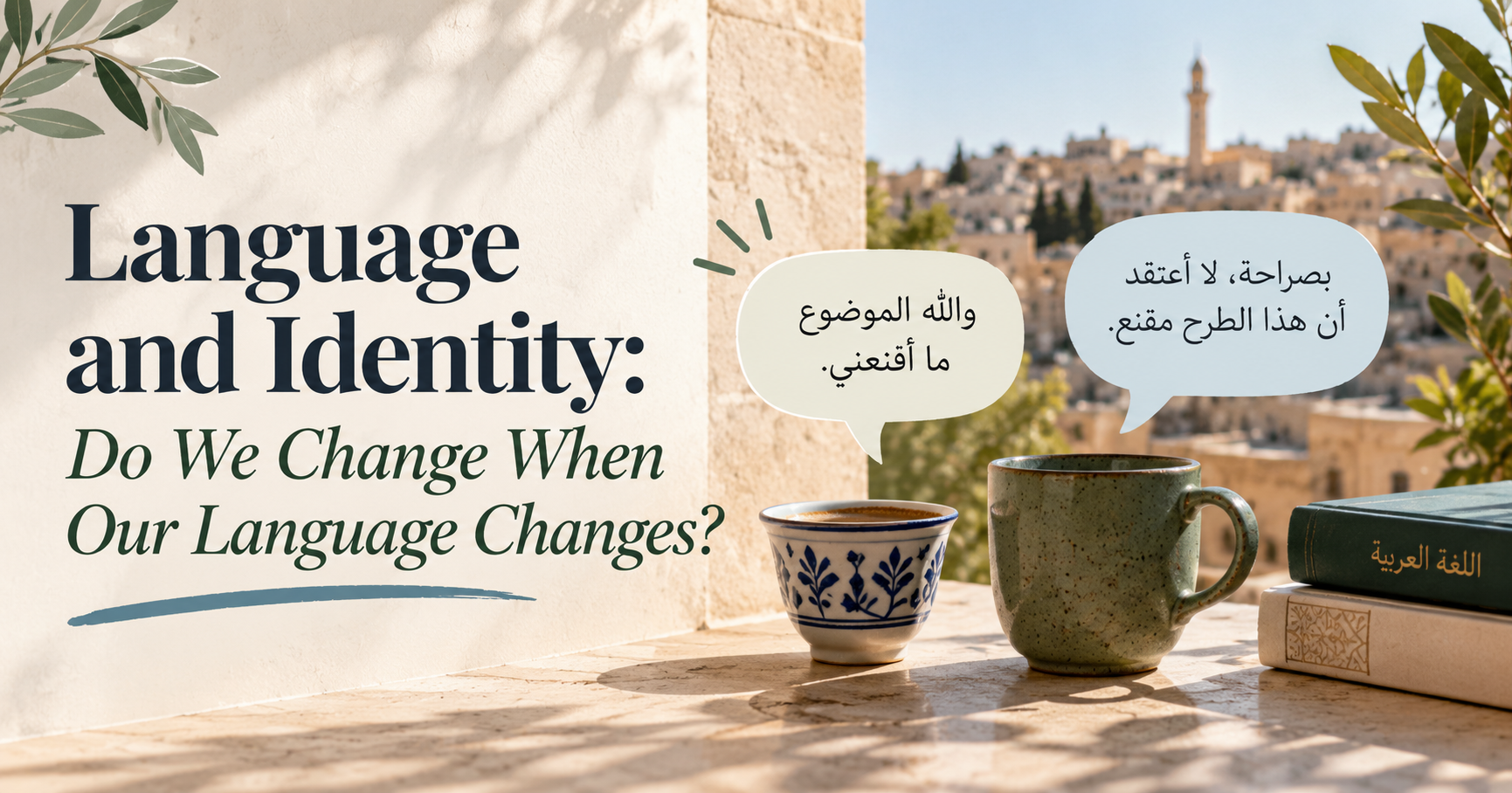
A friend might say in dialect:
والله الموضوع ما أقنعني.
(Wallah, il-mawdoo3 ma aqna3ni.)
“Honestly, I’m just not convinced.”
Then, in a meeting, the same person might say in Fusha:
بصراحة، لا أعتقد أن هذا الطرح مقنع.
(Bisaraha, la a‘taqid anna hatha at-tarh muqni‘.)
“Frankly, I don’t find this argument convincing.”
The idea is almost the same, but the language changes with the situation.
And it isn’t only about formality. The way we speak can also shift depending on where we live and who we spend time with. A Jordanian who lives in the Gulf for years, for example, might start using Khaleeji expressions without even noticing.
“Since When Do You Talk Like That?”
Eventually, someone back home might laugh and say:
“Since when do you talk like that? Living abroad changed your accent.”
It sounds like a joke, but underneath it is something more interesting.
We often connect the way someone speaks with where they belong. Keeping your dialect can almost feel like proof that your connection to home is still there.
But is identity really that simple?
Many heritage speakers understand their parents’ language perfectly but struggle to speak it fluently. A grandmother speaks Arabic, while her grandchild answers in English. They understand the jokes, the food, the family stories, and the cultural references, even if the active vocabulary is missing.
That doesn’t automatically make them less connected to their culture.
Belonging, Status, and Borrowed Words
Some expressions are difficult to translate because the meaning is not only in the words.
Take:
يعطيك العافية
(ya3teek el-3afyeh)
You can explain what it means in English, but a translation doesn’t completely capture when people say it, how it feels, or what it communicates socially.
Emotion also attaches itself to language.
Someone might discuss complicated topics all day in a second language and then switch immediately to their first language when they’re angry, scared, surprised, or talking to their mother.
Sometimes one language simply feels closer.
Language can also carry social status.
Certain dialects may be associated with education, wealth, a particular city, or social class, while others are unfairly treated as rural, informal, or unsuitable for professional situations.
Because of that, people sometimes soften or change their dialect in interviews, universities, or workplaces. Not necessarily because they are ashamed of the way they speak, but because they know people may judge their language before they judge what they are actually saying.
And Then the Internet Changed Everything
Today, our linguistic identities are becoming even more mixed.
A young Jordanian might watch an Egyptian series, hear Khaleeji Arabic on TikTok, speak Jordanian Arabic with family, use Fusha at university, and say words like meeting, deadline, or email at work.
All in the same day.
And then comes the familiar question:
“Why don’t you just speak Arabic?”
But languages have always borrowed from one another. Arabic is no exception.
Maybe the more interesting question is not whether we borrow words, but why we choose certain ones.
Do we use them because they are convenient? Because there is no perfect equivalent? Because everyone around us uses them?
Or sometimes because another language carries a certain image of being more modern, professional, or educated?
The words we choose can reveal much more than vocabulary.
One Identity, Several Languages
For many people, linguistic identity is not one language or one dialect.
It might be a language for work, another for university, a dialect for family, expressions borrowed from friends, and words picked up from places they have lived.
Eventually, the question “What is your mother tongue?” might not tell the whole story.
Language changes as we move through different places, relationships, and stages of life.
And still, however much the way we talk changes, something in it often gives away where we started.
Arabic makes this especially visible.
Fusha and dialect are not competing versions of the same language. They serve different purposes, carry different emotions, and open different doors.
For learners, this is why understanding both can be so valuable. Fusha gives learners access to books, news, formal communication, and content from across the Arabic-speaking world. Dialect gives access to everyday conversations, humor, relationships, and the way people actually speak to one another.
Neither tells the whole story on its own.
Together, they give a much fuller picture of Arabic and of the people who speak it.
What about you? Do you feel different when you switch between Fusha, dialect, or another language? Share your experience below.